Mental Models of AI
Workshop on Mental Models of AI: Bridging Elicitation Methods and Stochastic Systems
- Where
- 🇺🇸 Pittsburgh, USA
- When
- May 2027 · day TBA
- Co-located with
- ACM CHI 2027 ↗
Important Dates
- 01Call for participationDec 17, 2026
- 02Paper submission deadlineFeb 11, 2027
- 03Authors notifiedBy Feb 25, 2027
- 04CHI registration deadlineMar 4, 2027
- 05Materials shared with participantsAt least 1 week before the workshop
- 06Workshop at ACM CHI 2027, PittsburghMay 2027 · day TBA
About this workshop
At ACM CHI in Pittsburgh in May 2027, groups will draw a research method and an AI system, then sketch a study of how people understand that system. CHI will announce the workshop day.
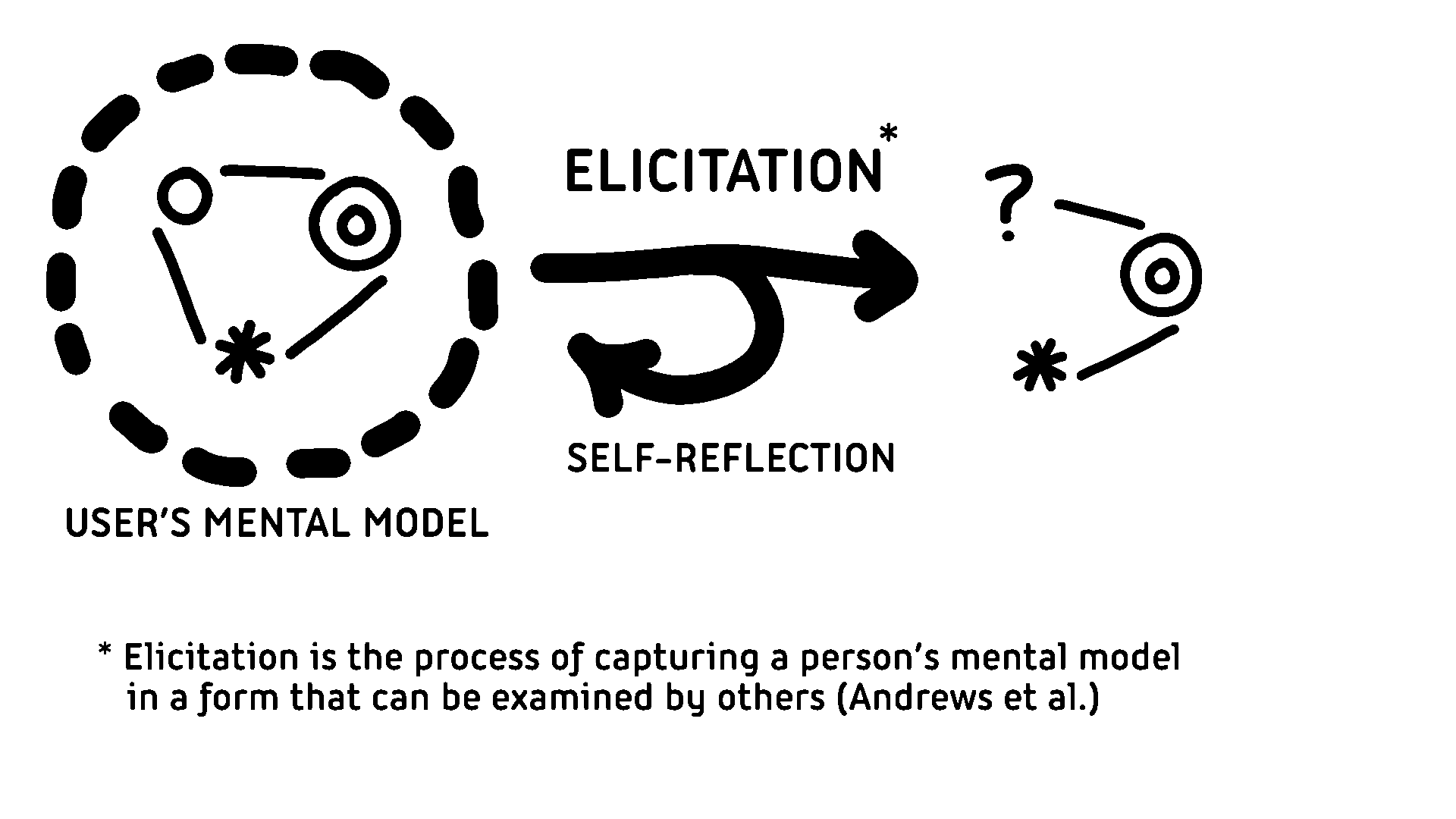
Human-AI interaction researchers elicit people's mental models of how AI systems work using methods such as think-alouds and free drawing. Each method captures different aspects of a mental model, so conclusions about the same user can differ across methods. As AI systems become more varied, multi-purpose, and embedded in people's lives, how can researchers faithfully capture mental models of them?
This workshop examines what elicitation methods make observable, how generative and agentic AI complicate existing approaches, and which research questions we should pursue together. Each table draws a method card and an AI system card. Participants start a study sketch together before the break and pick it up at the same table afterward. They then visit another table to discuss its sketch and bring feedback home to revise their own. The revised decks and a co-authored position paper will help researchers choose and compare methods across AI systems.
Building on the IUI 2027 edition, the CHI workshop turns insights from elicitation exercises and a systematic review of 88 empirical studies into a shared resource for planning, reporting, and teaching mental model research.
Call for papers
How do elicitation methods and the AI systems they target shape what a study can conclude?
We invite researchers and practitioners from HCI, AI, psychology, cognitive science, design, and industry. No prior experience with elicitation is required; the activity cards provide referenced definitions and method descriptions.
We welcome empirical studies, reanalyses of existing data, methods, theory, reflexive accounts, and provocations on mental models of AI or adjacent constructs such as perceptions, sensemaking, and schemata.
If a paper describes a method or AI system missing from the decks, we’ll add it. We’ll select four papers covering different methods and systems for lightning talks.
- Page limit
- 2–8 pages, excluding referencesReferences do not count toward the page limit.
- Template
- ACM single-column format, anonymized PDF · template ↗Name the AI systems and any elicitation methods involved, and anonymize the submission for review.
- Review
- At least two double-blind reviews per submission on OpenReviewOrganizers and external program committee members will assess relevance, methodological or theoretical insight, and potential to inform discussion of study design.
- Submission portal
- OpenReviewWe’ll post the link here when submissions open.
- Questions
- workshop@mentalmodelsofai.comAs a backup, email Bhada Yun at bhayun@ethz.ch
Invited speakers

Second invited speaker
TBC
Workshop Program
After a worked example, you’ll work in groups of about six people from different disciplines. Your table has 35 minutes across the two sessions to sketch a study. In the last 15 minutes of session 1, introduce yourselves, draw a method card and an AI system card, choose a research question, and start a study sketch. You can swap a card if the method or system is unfamiliar.
Return to the same table for the first 20 minutes of session 2. Add enough detail for another group to discuss your sketch. For example, what would someone who understands the system be able to explain or predict? Next, visit another table to critique its sketch. When you return, use the feedback others left to revise yours. You can also suggest changes to the cards. We’ll close with table reports and a discussion of shared research priorities.
Two 90-minute sessions with a break, in person at CHI 2027.
We expect 40–50 people, including organizers and speakers. Authors of accepted papers receive priority. Other CHI attendees are welcome.
Times run from the start of each session. If groups need a little longer on the day, we can move five minutes from the critique round to sketching. CHI will announce the workshop day and start time.
Session 1 · Framing and research questions
0:00 – 0:05Welcome and table assignment- 0:05 – 0:15Introduction to mental models in human-AI interaction
- 0:15 – 0:35Invited talks: Zahra Ashktorab (confirmed) and a second speaker (TBC)
- 0:35 – 1:05Four lightning talks: five minutes per paper, followed by questions
- 1:05 – 1:15Worked example with the elicitation-method and AI-system decks
- 1:15 – 1:30Round 1 begins. Introduce yourselves, draw cards, choose a question, and start your study sketch
Session 2 · World café study design
0:00 – 0:20Round 1 continues. Rejoin your table and develop the sketch, including what you would count as a well-formed mental model- 0:20 – 0:40Round 2. Visit another table and critique its sketch
- 0:40 – 1:00Round 3. Revise your table’s sketch and suggest changes to the cards
- 1:00 – 1:15Table reports
- 1:15 – 1:25Group discussion of research priorities
- 1:25 – 1:30Closing and next steps
After acceptance
- 01
Non-archival papers, shared with permission
Participant papers will be non-archival. Accepted papers will be shared with participants before the workshop and, with authors' permission, posted on the workshop website and in a public Zenodo community. Selected study sketches will also be shared with contributors' permission.
- 02
Register and attend in person
At least one author per accepted paper must register for CHI and attend in person. Four accepted papers, chosen to span methods and systems, will receive five-minute lightning-talk slots with two minutes for questions. All attendees take part in the group activities.
- 03
Prepare with accessible materials
Accepted papers, accessible digital versions of the cards, and activity instructions will be shared with participants at least one week before the workshop.
- 04
Open card decks, prompts, and a workshop summary
The revised elicitation-method and AI-system decks, prompts, and workshop summary will be freely downloadable from this website as resources for planning, reporting, and teaching mental model research.
- 05
A co-authored position paper
Participants will be invited to co-author a paper synthesizing study sketches and shared research priorities, with CHI 2028 or ACM Interactions as preliminary targets. Contributors will be credited as co-authors or, with permission, in the acknowledgments. Follow-up will be coordinated through the mailing list and Slack.
Organizers & Program Committee
The organizing team combines first-hand research experience about mental models in human-AI interaction and a strong motivation to reopen discussions within the CHI community.





Dr. Qiaosi (Chelsea) Wang
Carnegie Bosch Postdoctoral Fellow · Co-organizerCMU HCII



PD Dr. Nadine Bienefeld
Senior Lecturer and Senior Researcher · Co-organizerETH Zürich · University of Lucerne
Prof. Dr. Hari Subramonyam
Assistant Professor (Research) · Co-organizerStanford University

Prof. Dr. April Yi Wang
Assistant Professor · Co-organizerETH Zürich · PEACH Lab
Program Committee
 Prof. Dr. Pat PataranutapornMIT Media Lab
 Dr. Magdalena WischnewskiUniversity of Duisburg-Essen
 Prof. Dr. Mennatallah El-AssadyETH Zürich
 Prof. Dr. Christoph HölscherETH Zürich