
April Yi Wang
April Yi Wang is an Assistant Professor of Computer Science at ETH Zurich, where she leads the Programming, Education, and Computer Human Interaction Lab (PEACH) and is the chair of ACM SwissCHI local chapter. Through projects on AI tutors, classroom chatbots, learner-LLM problem decomposition, and agency in AI-mediated software engineering, she examines how educational tools can scaffold accurate mental model formation and repair rather than obscure it.
She has served on the organizing committee of IEEE VL/HCC and regularly on the program committees of CHI, UIST, and Learning@Scale, as well as organized several workshops at CHI, IUI, and other venues.
Affiliation: Department of Computer Science, ETH Zürich.
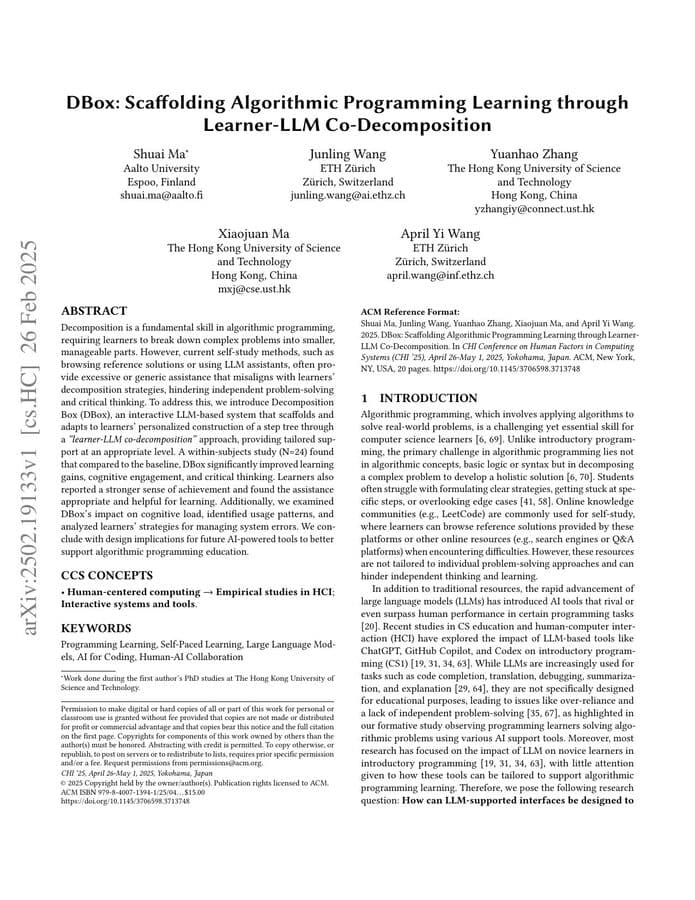
DBox: Scaffolding Algorithmic Programming Learning through Learner-LLM Co-Decomposition
Shuai Ma, Junling Wang, Yuanhao Zhang, Xiaojuan Ma, April Yi Wang
Proceedings of the 2025 CHI Conference on Human Factors in Computing Systems
Decomposition is a fundamental skill in algorithmic programming, requiring learners to break down complex problems into smaller, manageable parts. However, current self-study methods, such as browsing reference solutions or using LLM assistants, often provide excessive or generic assistance that misaligns with learners' decomposition strategies, hindering independent problem-solving and critical thinking. To address this, we introduce Decomposition Box (DBox), an interactive LLM-based system that scaffolds and adapts to learners' personalized construction of a step tree through a "learner-LLM co-decomposition" approach, providing tailored support at an appropriate level. A within-subjects study (N=24) found that compared to the baseline, DBox significantly improved learning gains, cognitive engagement, and critical thinking. Learners also reported a stronger sense of achievement and found the assistance appropriate and helpful for learning. Additionally, we examined DBox's impact on cognitive load, identified usage patterns, and analyzed learners' strategies for managing system errors. We conclude with design implications for future AI-powered tools to better support algorithmic programming education.