
Qiaosi (Chelsea) Wang
Qiaosi (Chelsea) Wang is a Carnegie Bosch Postdoctoral Fellow at Carnegie Mellon University, and an incoming assistant professor at UC Berkeley's School of Education. Her work focuses on theorizing, designing, and examining people's perceptions and mental models of conversational AI agents through the socio-cognitive lens of Mutual Theory of Mind across online learning, everyday life, and recently mental health contexts.
Chelsea has served on the program committees of premier HCI conferences such as CHI, DIS, and CSCW. She's also the lead organizer of the Theory of Mind in Human-AI Interaction (ToMinHAI) workshop series at CHI and CUI.
Affiliation: Carnegie Mellon University · incoming Assistant Professor, UC Berkeley School of Education.
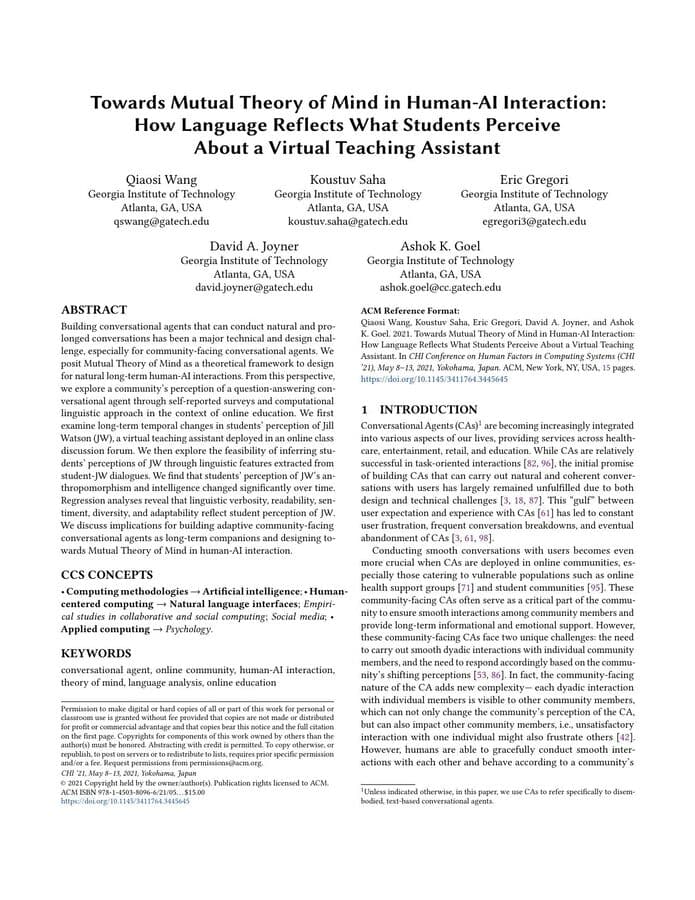
Towards Mutual Theory of Mind in Human-AI Interaction: How Language Reflects What Students Perceive About a Virtual Teaching Assistant
Qiaosi Wang, Koustuv Saha, Eric Gregori, David A. Joyner, Ashok K. Goel
Proceedings of the 2021 CHI Conference on Human Factors in Computing Systems
Building conversational agents that can conduct natural and prolonged conversations has been a major technical and design challenge, especially for community-facing conversational agents. We posit Mutual Theory of Mind as a theoretical framework to design for natural long-term human-AI interactions. From this perspective, we explore a community's perception of a question-answering conversational agent through self-reported surveys and computational linguistic approach in the context of online education. We first examine long-term temporal changes in students' perception of Jill Watson (JW), a virtual teaching assistant deployed in an online class discussion forum. We then explore the feasibility of inferring students' perceptions of JW through linguistic features extracted from student-JW dialogues. We find that students' perception of JW's anthropomorphism and intelligence changed significantly over time. Regression analyses reveal that linguistic verbosity, readability, sentiment, diversity, and adaptability reflect student perception of JW. We discuss implications for building adaptive community-facing conversational agents as long-term companions and designing towards Mutual Theory of Mind in human-AI interaction.