Mental Models of A.I.
[MeMoAI] Mental Models in Human-AI Interaction: Methods and Challenges in the Generative and Agentic AI Era.
- Where
- 🇫🇮 Helsinki, Finland
- When
- February 8–11, 2027 (exact day TBD)
- Co-located with
- ACM IUI 2027 ↗
Important Dates
- 01Workshop proposal submitted to IUI '27· doneJul 2026
- 02Workshop acceptance notificationTBD
- 03Call for papers releasedTBD
- 04Paper submission deadline· upcomingTBD
- 05Notification of acceptanceTBD
- 06Workshop at ACM IUI 2027, HelsinkiFeb 8–11, 2027 (exact day TBD)
About this workshop
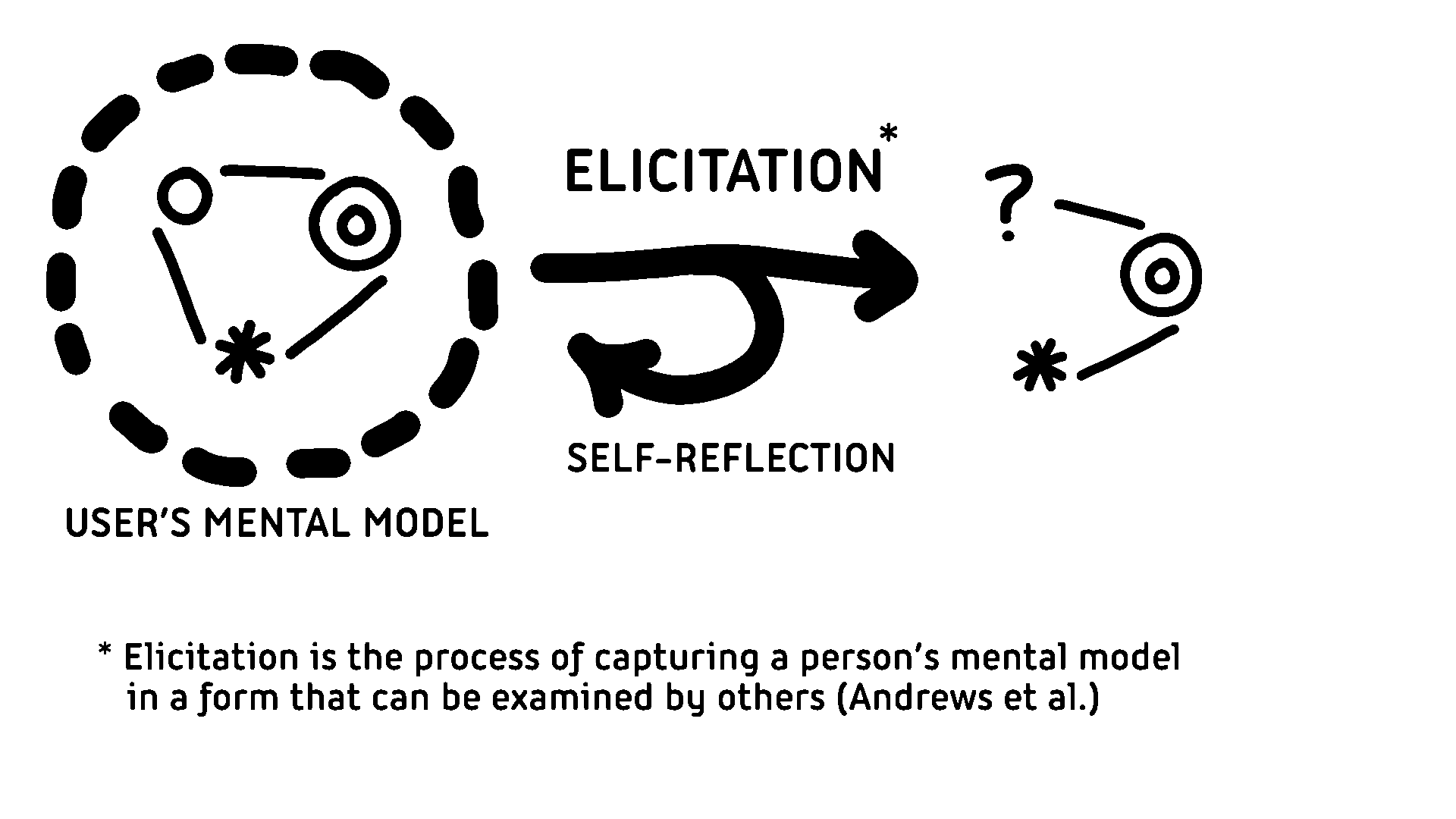
The mental model construct is widely used in HCI to refer to the knowledge structure people hold in order to reason about and interact with computing systems. Yet it is often operationalized intuitively: the construct is often used interchangeably with related concepts (e.g. folk theories, sensemaking) and the methods of studying it (e.g. through elicitation) are many and diverse, with each method resting on distinct assumptions about what counts as a mental model.
Generative and agentic AI systems may further complicate mental model formation and elicitation, as such systems are opaque by design, adaptive, and increasingly act on users' behalf across files, applications, and the web. Misconceptions about their behavior can have concrete consequences: a user believing a coding agent cannot read files listed in a .gitignore may inadvertently send sensitive data to a third-party provider. Together, these challenges may hinder the legibility and commensurability of research on people's mental models of AI systems. We argue it is therefore timely to dedicate a space for theoretical and methodological exchange on the construct at IUI '27.
The MeMoAI workshop calls for a critical reassessment of how we understand and study mental models in human-AI interaction research. Its objectives are threefold: (1) map elicitation practices, documenting and comparing how researchers conceptualize and study mental models of AI systems across research contexts; (2) operationalize mental models in the age of AI, surfacing the methodological challenges and opportunities of studying mental models of generative and agentic AI through submissions and hands-on elicitation exercises; and (3) reflect on the future of the construct, advancing discussion on how the mental model construct should be conceptualized and applied to remain relevant for contemporary AI systems.
For researchers and practitioners studying people's mental models of AI.
The workshop targets researchers and practitioners, from academia or industry, ideally with first-hand experience with people's mental models of AI in the context of HCI. We welcome researchers and practitioners from HCI, AI, psychology, cognitive science, design, and related fields to encourage interdisciplinary discussion.
The organizing team combines first-hand research experience about mental models in human-AI interaction, experience in community-building activities, and a strong motivation to reopen and shape future research on these topics within the IUI community.
Methods for studying mental models
Machine teaching, elicitation methods, and a systematic review of 88 empirical studies on mental models in HAI.
Mental models and phenomenology of HAI
Phenomenological methods eliciting how people subjectively perceive, make sense of, and relate to AI systems.
Group collaboration and AI literacy
Generative-AI agents for team collaboration; how mental models of conversational AI evolve over time.
Multisensory interaction and adaptive UIs
Modeling human perception and cognition; learning user mental models from multimodal interaction traces.
AI governance and accountable systems
Transparency and governance requirements that give stakeholders meaningful agency and recourse over systems.
NLP and human–LM collaboration
Linguistic user behavior during LLM-assisted task solving; interactive systems for human–LM collaboration.
We're inviting researchers of
★ submit if any of these is you- HCI and interaction design
Interface evaluation, transparency cues, novel UI affordances for AI.
- Cognitive psychology
Empirical foundations of model-based reasoning and metacognition.
- Educational technology and learning sciences
AI tutors, classroom chatbots, and how educational tools scaffold mental model formation and repair.
- ML and NLP with interactive evaluation
Researchers building human-in-the-loop evaluation protocols for LMs and agents.
- Design research
Drawings, card sorting, and other artifact-based probes of mental models.
- AI evaluation and auditing
Connecting interface evaluation with model auditing and accountability work.
Not on this list? Send us your work anyway. The point of the workshop is to find the disciplines we missed.
Workshop Themes
We invite contributions to one or more of the following themes. Each theme has a set of motivating research questions; submissions can engage any subset, propose a new one, or critique the framing itself.
- Theme 01
Operationalization Methods
Can mental model elicitations be meaningfully compared within and across studies?
Research questions- 01Can mental model elicitations be meaningfully compared within and across studies?
- 02What assumptions underlie different elicitation methods, from researcher-led and participant-led verbalizations to structured judgments and artifact-based methods?
- 03Is commensurability of mental model research desirable or achievable?
Keywords- elicitation methods
- interviews
- think-aloud
- prediction tests
- free drawing
- card sorting
- commensurability
- Theme 02
Contemporary AI Systems
How do generative and agentic AI systems challenge existing assumptions about mental models?
Research questions- 01How do contemporary AI systems challenge existing assumptions about mental models and their elicitation?
- 02What are (un)suitable classes of methods for systems that are opaque by design, adaptive, and increasingly act on users' behalf?
- 03What are the concrete consequences of misconceptions about generative and agentic AI behavior?
Keywords- generative AI
- agentic AI
- LLMs
- opacity
- adaptivity
- misconceptions
- Theme 03
Conceptual Boundaries
What makes the mental model construct distinctive from adjacent constructs?
Research questions- 01What makes the mental model construct distinctive from adjacent constructs such as folk theories, sensemaking, schemata, and anthropomorphism?
- 02When is the mental model the right lens, and when is a neighboring construct doing the actual work?
Keywords- folk theories
- sensemaking
- schemata
- anthropomorphism
- construct validity
- Theme 04
Dynamics
How can researchers capture mental models that keep evolving through interaction?
Research questions- 01How can researchers capture the dynamic nature of mental models, given mental models continue to evolve through interaction with a system?
- 02What longitudinal and in-situ approaches can track mental model formation and repair over time?
Keywords- dynamics
- longitudinal methods
- mental model formation
- interaction traces
- Theme 05
Research and Design Value
What does mental model elicitation buy the design of intelligent user interfaces?
Research questions- 01What insights does mental model elicitation provide for the design of intelligent user interfaces?
- 02Could similar insights be obtained through other approaches?
Keywords- design value
- intelligent user interfaces
- evaluation
- design implications
What to Submit
- 01 · component
Short paper
We invite short papers on users' or stakeholders' mental models of AI systems, particularly contributions that reflect on the conceptual and methodological foundations of the construct. Empirical studies, methodological notes, theoretical positions, and critical reflections are all welcome. Page limit and formatting details: TBD with the call for papers.
How to Submit
- Page limit
- TBD (released with the call for papers)
- Template
- ACM template (details TBD) · template ↗
- Review
- Double-blind peer review on OpenReview, supervised by a program committee. Each submission will receive at least two reviews from a pool of reviewers comprising co-organizers and externally recruited researchers, with conflicts of interest managed through OpenReview. See the Program Committee section below for its provisional members.
- Submission portal
- OpenReview. Link will appear here once the call for papers opens.
- Questions
- workshop@mentalmodelsofai.com
Workshop Format
Half-day (3.5 hours), in person at IUI '27.
We expect 25–30 participants, including organizers, authors of accepted submissions, and attendees admitted through open registration.
- 0:00 – 0:15Introduction (Dr. Téo Sanchez): workshop goals and themes, and a short genealogy of the mental model construct
- 0:15 – 0:50Selected lightning talks: five submissions presented in a 5-minute lightning format, followed by 2 minutes of questions
- 0:50 – 1:30Peer elicitation exercise: participants work in pairs to elicit each other's mental model of a coding agent or a text-to-image generator
- 1:30 – 2:00Coffee break (the previous activity may continue)
- 2:00 – 3:00Breakout discussions: groups tackle open questions on the future of mental model research in the context of contemporary AI systems
- 3:00 – 3:30Report-back and closing discussion: each group shares insights, points of disagreement, and priorities for future research
What Happens After Acceptance
- 01A public Zenodo archive will gather accepted papers, workshop materials, discussion summaries, and selected elicitation artifacts (subject to participants' consent).
- 02The workshop website will remain online after the event and serve as a hub for accessing these materials.
- 03We plan to collaboratively produce a short workshop report synthesizing key insights and future research directions identified during the discussions, deposited on Zenodo and HAL and linked from this website. All interested participants will be invited to contribute.
Organizers
The organizing team combines first-hand research experience about mental models in human-AI interaction, experience in community-building activities, and a strong motivation to reopen and shape future research on these topics within the IUI community. Click any organizer for their full bio and profile links.

Téo SanchezMSCA Postdoctoral Fellow · Main contactLMU Munich · MI³Rethinks users as proactive machine teachers; led a systematic review of 88 empirical studies on mental models in human-AI interaction.

Bhada YunPhD Student · Co-organizerETH ZürichDevelops phenomenological methods for studying human-AI interaction, recognized with four CHI Honorable Mention Awards.

Prerna RaviPhD Student · Co-organizerMIT CSAILDesigns generative AI agents that augment team collaboration in education, creative practice, and collective decision-making.

Laura SchützPhD Candidate · Co-organizerTUMModels human perception and cognition for adaptive user interfaces; incoming ETH AI Center Postdoc Fellow learning user mental models from multimodal interaction traces.

Anna NeumannPhD Candidate · Co-organizerUniversity Duisburg-Essen · RC TrustStudies transparency and governance requirements that give stakeholders meaningful agency and recourse over technical systems. CHI Best Paper Award.
Robin ChanPhD Candidate · Co-organizerETH ZürichStudies linguistic user behavior during LLM-assisted task solving and designs interactive systems for human–LM collaboration. CHI Best Paper Award.

April Yi WangAssistant Professor · Co-organizerETH Zürich · PEACH LabLeads the PEACH Lab at ETH Zürich; examines how educational tools can scaffold accurate mental model formation and repair rather than obscure it.

Qiaosi (Chelsea) WangCarnegie Bosch Postdoctoral Fellow · Co-organizerCMU HCIIStudies people's perceptions and mental models of conversational AI agents through the socio-cognitive lens of Mutual Theory of Mind.

Sumit AsthanaSenior Applied Scientist · Co-organizerMicrosoftAdvances AI assistants and agentic systems at Microsoft, with a focus on aligning AI systems with human mental models.
Program Committee
Submissions will undergo double-blind peer review on OpenReview, supervised by a program committee. Each submission will receive at least two reviews from a pool of reviewers comprising co-organizers and externally recruited researchers, with conflicts of interest managed through OpenReview. Program committee members will oversee review quality and make final recommendations. Besides quality, reviews will prioritize relevance to the workshop themes, methodological and theoretical insight, and potential to stimulate discussion. The provisional members of the program committee are:
- Prof. Dr. Simone StumpfUniversity of Glasgow
- Dr. Doga DoganAdobe Research
- Dr. Magdalena WischnewskiUniversität Duisburg-Essen
- Prof. Dr. April Yi WangETH Zürich
- Dr. Qiaosi (Chelsea) WangCarnegie Mellon University
- Dr. Sumit AsthanaMicrosoft Research
Submit a paper.
We're gathering researchers and practitioners across HCI, AI, psychology, cognitive science, and design: anyone studying people's mental models of AI systems. If that's your work, we want it in the room.
Submission portal will appear here as soon as the workshop is accepted.
Questions: workshop@mentalmodelsofai.com