
Bhada Yun
Bhada Yun is a PhD student at ETH Zürich studying Machine Intelligence and Visual & Interactive Computing. His work develops phenomenological methods for studying human-AI interaction, eliciting how people subjectively perceive, make sense of, and relate to AI systems, with the aim of aligning AI to human wellbeing and agency.
His research has been recognized with four CHI Honorable Mention Awards.
Affiliation: Department of Computer Science, ETH Zürich.
Does My Chatbot Have an Agenda? Understanding Human and AI Agency in Human-Human-like Chatbot Interaction
Bhada Yun, Evgenia Taranova, April Yi Wang
Proceedings of the 2026 CHI Conference on Human Factors in Computing Systems
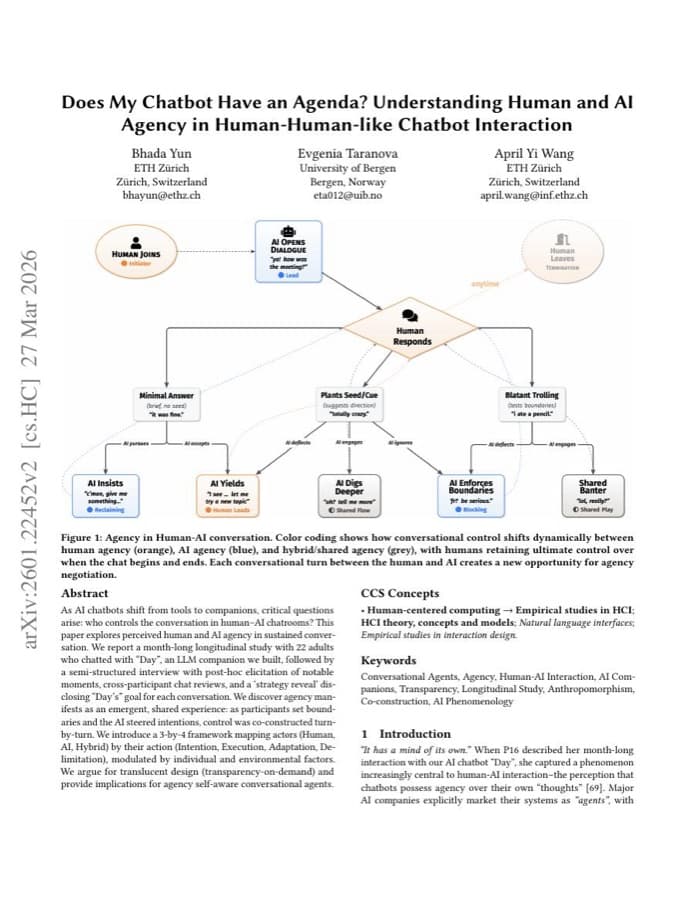
As AI chatbots shift from tools to companions, critical questions arise: who controls the conversation in human-AI chatrooms? This paper explores perceived human and AI agency in sustained conversation. We report a month-long longitudinal study with 22 adults who chatted with Day, an LLM companion we built, followed by a semi-structured interview with post-hoc elicitation of notable moments, cross-participant chat reviews, and a 'strategy reveal' disclosing Day's goal for each conversation. We discover agency manifests as an emergent, shared experience: as participants set boundaries and the AI steered intentions, control was co-constructed turn-by-turn. We introduce a 3-by-4 framework mapping actors (Human, AI, Hybrid) by their action (Intention, Execution, Adaptation, Delimitation), modulated by individual and environmental factors. We argue for translucent design (transparency-on-demand) and provide implications for agency self-aware conversational agents.