
Janet Pauketat
Janet V. T. Pauketat is a Research Fellow at the Sentience Institute. She holds a PhD in Psychological & Brain Sciences from UC Santa Barbara and a Master of Research from the University of St Andrews, where she studied the psychology of socio-cultural context and morally-expanding capacities of global citizenship.
After her PhD she studied collective emotions in social movements as a postdoctoral research associate at Princeton University. She has worked with researchers at the University of St Andrews on moral values in social movements and at the National University of Singapore on values affecting immigration attitudes.
Her recent work, including a CHI 2026 paper with N = 2,702, disentangles the mental models of autonomy and sentience and shows how each independently shapes mind perception, moral consideration, and perceived threat from AI.
Affiliation: Sentience Institute · prev. UC Santa Barbara, Princeton.
Janet's prior work.
These papers are notsubmissions to the Mental Models of AI workshop. The workshop hasn't happened yet. They are the body of work Janet brings to the committee, verified against personal sites and Google Scholar.
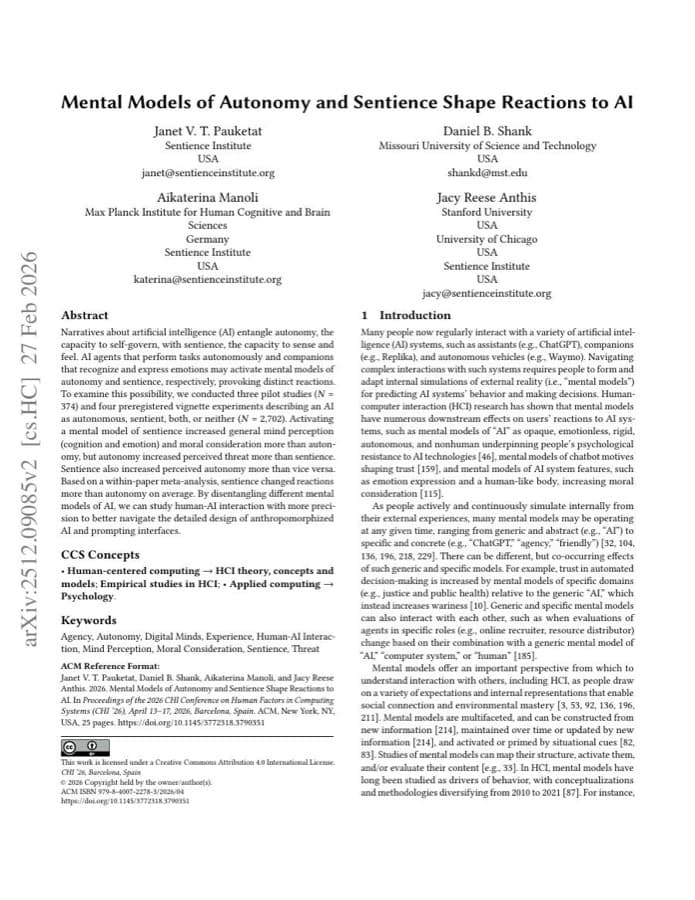
Mental Models of Autonomy and Sentience Shape Reactions to AI
Three pilot studies and four pre-registered experiments (total N = 2,702) test how distinct mental models of AI shape downstream reactions. Activating sentience increases mind perception and moral consideration; activating autonomy increases perceived threat. Sentience changes reactions more than autonomy on average, and disentangling the two enables more precise human-AI interaction research.